
Hey, Sean here again, and a common thing I’ve seen when working with clients is low close rates on bigger deals, while the smaller deals will be no problem.
Sure a 30% close rate is great in this industry, but what does it matter when all you’re closing is 20k deals? And this is a huge problem when you start running ads spending large amounts of money per day trying to generate leads.
If you’re an ISO (Independent Sales Organization) trying to close $50K to $250K+ deals, you’re probably running into a familiar problem:
You have leads. You do the follow-up. But you’re still hearing: “Let me think about it,” or worse, you’re getting ghosted.
What gives?
The truth is, your problem isn’t the leads. It’s how you’re selling. Most ISOs use brute force tactics—quote fast, close hard. But when you’re dealing with business owners who have serious money on the line, that just doesn’t work.
What does work? Consultative sales. Specifically: SPIN Selling—a proven method used in enterprise-level sales to sell complex, high-ticket solutions.
Let’s break it down.
The Real Reason Your High-Ticket Deals Are Stalling
Selling a merchant cash advance or term loan is not the same as selling a $99 gadget.
It’s complex. It’s risky (for the merchant). And it requires trust.
Here’s the painful truth: Most business owners don’t care about your rates or how fast you can fund.
They care about:
- Will this fix their problem?
- Are you just another commission-chasing agent?
- Will this bite them in the ass later?
SPIN Selling reframes the entire sales process. It helps you become a trusted advisor, not a pest.
Pushy Sales vs Consultative Sales…
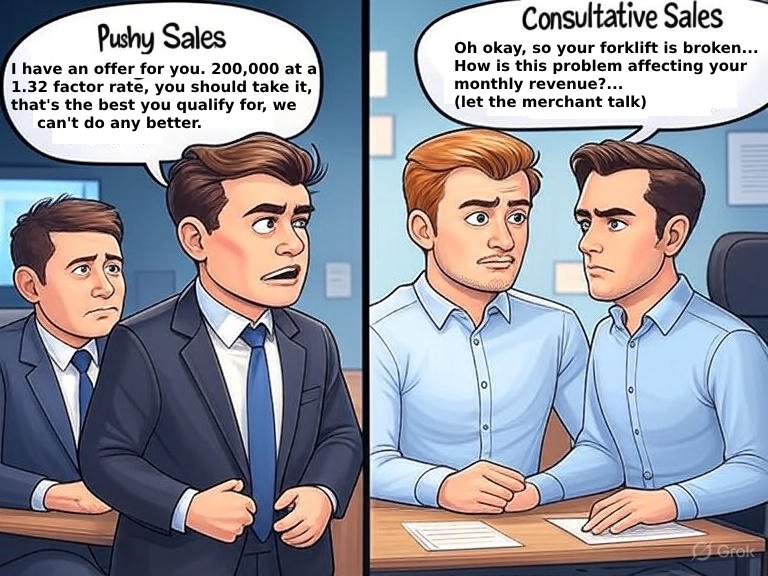
| Pushy ISO Rep | SPIN-Based ISO Rep |
|---|---|
| Talks 80% of the time | Listens 80% of the time |
| Jumps into rates and terms right away | Starts by asking business questions |
| Pressures merchant to sign now | Helps merchant uncover real needs |
| Assumes every business wants fast capital | Identifies which businesses actually benefit from MCA |
| Focus on product features | Focus on solving business problems |
The SPIN Framework Explained (for ISOs)
SPIN stands for:
- Situation
- Problem
- Implication
- Need-Payoff
Each phase builds trust, reveals the real pain, and sets up the close without being pushy.
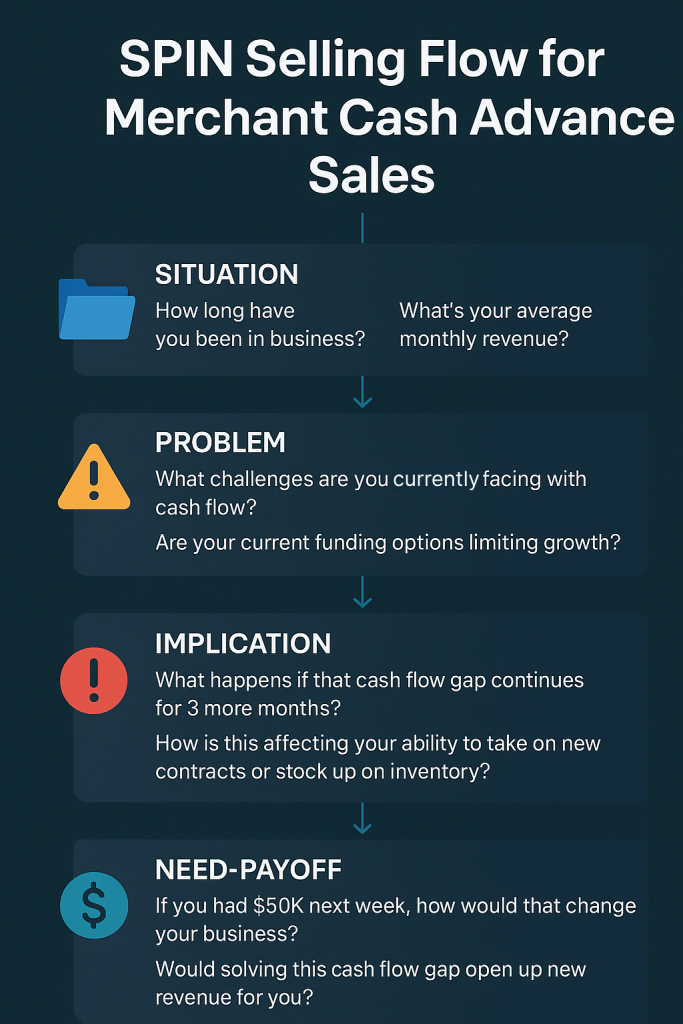
S = Situation
Gather context.
You want to know:
- What do they currently use to fund their business?
- How long have they been in business?
- What’s their monthly revenue?
- Are they seasonal or steady?
Avoid turning this into an interrogation. Be conversational.
Bad:
“How long have you been in business? How much revenue? How much do you process monthly?”
Better:
“Walk me through how you’re handling cash flow during slow months.”
P = Problem
Now, dig into what’s not working.
Examples:
- “What challenges have you run into trying to grow this year?”
- “What happened last time you tried getting funding from a bank or another lender?”
- “How are you handling payroll when revenue dips?”
You’re uncovering pain.
I = Implication
This is the money zone.
You amplify the cost of inaction:
“If you can’t get funding in the next 10 days, what happens to your inventory orders?”
Or:
“How does missing this opportunity affect your Q4 projections?”
This is where urgency naturally appears without you forcing it.
N = Need-Payoff
Let them sell themselves on the solution.
“If you had the capital in-hand next week, how would that change your situation?”
You’re helping them visualize the win they care about—not the funding, but what the funding does.
How to Plug SPIN Into Your Sales Process
- Use SPIN to structure discovery calls.
- Don’t pitch until you’ve gone through all four steps.
- SPIN can also be used in text/SMS follow-ups: Ask one question at a time to re-engage.
Example SMS:
“Hey John, last time we spoke you mentioned cash flow gets tight during winter. Can I ask what that’s been like this year?”
It’s consultative, non-threatening, and keeps the convo going.
Here’s how your calls should flow according to the SPIN framework:
Common Mistakes (And How to Fix Them)
- Mistake: Treating SPIN as a checklist.
- Fix: Make it a conversation, not a script.
- Mistake: Quoting too early.
- Fix: Don’t quote until you know their pain and what’s at stake.
- Mistake: Skipping Implication.
- Fix: Always explore what happens if the problem isn’t fixed.
SPIN Done Right vs SPIN Done Wrong:
| Bad | Good |
| Leads with product | Leads with questions |
| Talks 80% | Listens 70% |
| Focuses on rate | Focuses on ROI & urgency |
Why SPIN Works So Well for High-Ticket Financial Offers
- It builds trust by focusing on them, not you.
- It creates urgency organically.
- It positions you as a real advisor, not a rep.
- It’s perfect for closing bigger deals with more complexity and risk.
Final Thoughts: What To Do Next
If you’re serious about closing more deals, SPIN isn’t just a method—it’s a mindset shift.
Start using it today on your next call. Start slow. Practice.
Want More?
- Download our SPIN Call Template to help structure your next call
- Or if you want help building a full inbound lead gen system that brings in better leads and sets up easier closes, book a free strategy call or join our course.
Let’s get you more qualified leads and better closes.
I’ve created a 30 minute video case study that reveals the EXACT step-by-step system to:
- Target merchants who are shopping right now and need funding right now
- Get the merchants bank statements BEFORE you ever even get on the phone with them
- Create a magnetic effect where merchants come to you instead of you going to them, getting hung up on, or cursed at over the phone
[Case Study] How To Get The Freshest Leads In The Business
 Your email is 100% safe. No spam. No B.S.
