
The MCA industry is currently split into two camps. On one side, you have the “old guard” who are still grinding through UCC lists and getting hung up on 400 times a day. On the other, you have the digital-first shops that are pouring money into Facebook and Instagram. But there is a problem… most of the people running ads are getting absolutely cooked because they don’t understand the backend math or the creative velocity required to survive.
The $15,000 a Day Reality Check
If you think you can just “try out” some ads with a couple of hundred bucks, you need to see what the actual competition looks like. Some of the most successful marketers in the space are spending $15k a day across their accounts. That is a staggering amount of volume, but it comes with a catch… you have to be relentless.
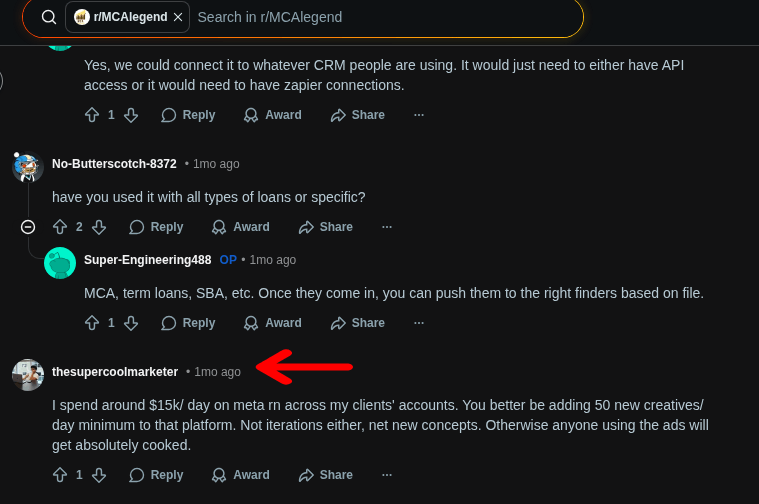
As the user “thesupercoolmarketer” pointed out, at that level of spend, you aren’t just tweaking a headline. You are adding 50 net-new creative concepts every single day. If you don’t have a system that can handle that kind of creative output, the algorithm will chew you up and spit you out. Most ISOs don’t have the time to be a full-time ad agency while they are trying to close deals… and they shouldn’t have to.
The Truth About the $73 Lead
One of the most revealing threads recently came from a Marketing Director at a direct lender. He was transparent about his numbers: $1.3 million in budget generated about $10.6 million in funded business. On the surface, that looks like a win. But when you look at the forensic accounting of the leads, the efficiency starts to leak.
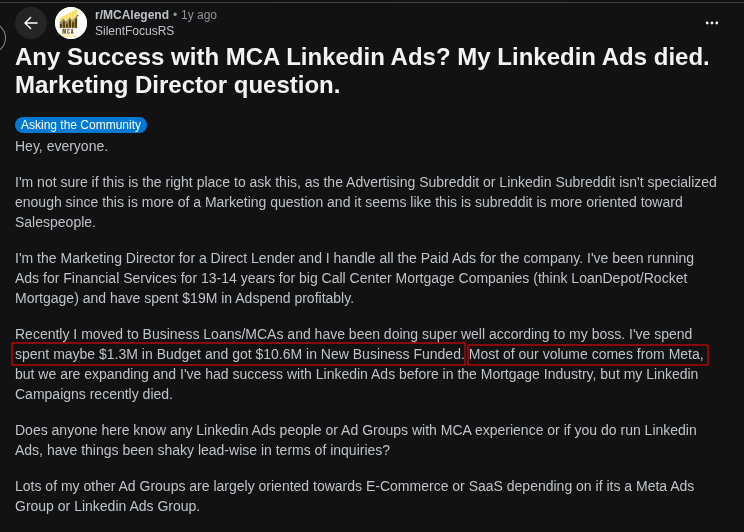
When you run the numbers on 1,600 leads a month against that million-dollar spend, you are looking at roughly $73 per lead.
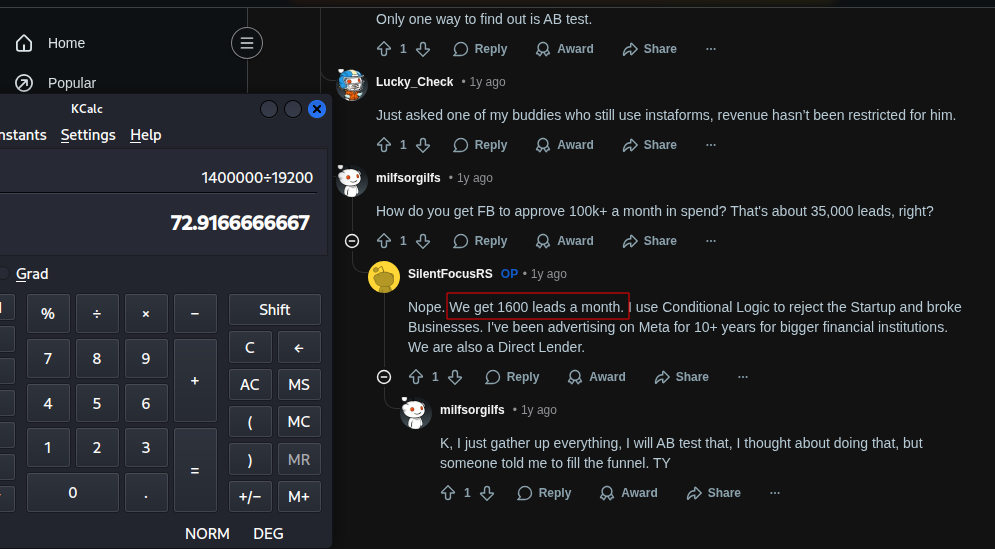
For a massive funder, $73 a lead is acceptable. For a growing ISO, that is a massive hurdle… especially when you consider that most of those 1,600 leads are just names and phone numbers. This is where my system diverges from the “big box” approach. I’ve been able to maintain lead costs far below that $73 mark, even after filtering for high-revenue merchants making over $20k to $40k a month.
The difference is in the friction. Instead of just “filling the funnel” with low-intent clicks, we are getting the loan application and the bank statements uploaded before you even pick up the phone. You aren’t chasing a lead… you are reviewing a file.
The “Wide River” Strategy for Scalability
You don’t need a million-dollar budget to start seeing success, but you do need enough “water” in the system to actually catch something. I typically recommend that ISOs start with at least $500 a day. This is the baseline required to generate enough volume for the system to at least break even while the algorithm learns who your ideal customer is.
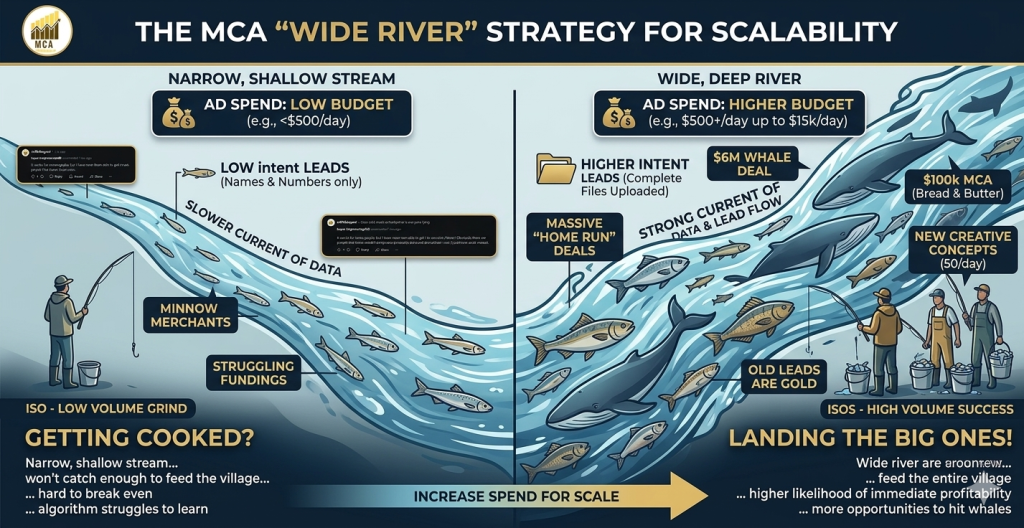
Think of it like fishing. If you are casting your line into a narrow, shallow stream where the water barely moves, you aren’t going to catch enough to feed the village. To land the big ones, you need a wide river with a strong current of data and lead flow. While $500 a day is the starting point, the more you can spend, the higher the likelihood of being profitable immediately. Higher volume simply means more opportunities to hit those massive “home run” deals that change your entire month.
Where the “Whales” Are Actually Hiding
There is a common misconception that “whales” (those massive $1M+ fundings) only come from high-level networking or exclusive, expensive lists. The reality is that these business owners are on Facebook just like everyone else.

While the community often asks where to find these huge numbers, the answer is usually right in front of them. One user, “Super-Engineering488,” noted that they get all of their whales through Facebook ads. We are talking $6M deals, $1.7M deals, and $1.6M fundings.

The secret isn’t just “finding” them… it’s having a system that can “layer” them. You need the steady $100k MCA deals to keep the lights on and the cash flowing, while you wait for the $1M+ deals to bake. Those big deals take longer and have a higher chance of falling apart at the finish line, so your inbound system has to be robust enough to support that waiting period.
Why Cold Outreach is a Dying Game
We’ve all seen the threads. People asking if cold email actually works or if everyone is just lying about their results. The sentiment is shifting rapidly.

Even the most experienced operators are admitting they’ve “never” been able to make cold email work. It’s a specialized skill set that is becoming harder by the day as spam filters get smarter. If you are still relying on cold outreach, you are fighting an uphill battle against technology. Moving to an inbound Meta system isn’t just a “growth strategy”… it’s a survival strategy.
The SMS Dilemma: High Reward, High Risk
While cold email is struggling, many ISOs have pivoted to SMS marketing. It remains a fantastic source of organic revenue and is often the “low-hanging fruit” for quick fundings. However, building your entire business on SMS is a dangerous game. Between carrier filtering, strict TCPA regulations, and the constant threat of phone number “shadow-banning,” nobody knows if SMS will remain a viable channel long-term. It’s a great tool to have in the shed, but you shouldn’t rely on it to be your only source of truth.
The “Old Leads are Gold” Principle
Perhaps the most important lesson from the high-volume spenders is the value of the “tail.” Many ISOs turn off their ads because they don’t see an immediate ROI in week one. That is a fatal mistake.
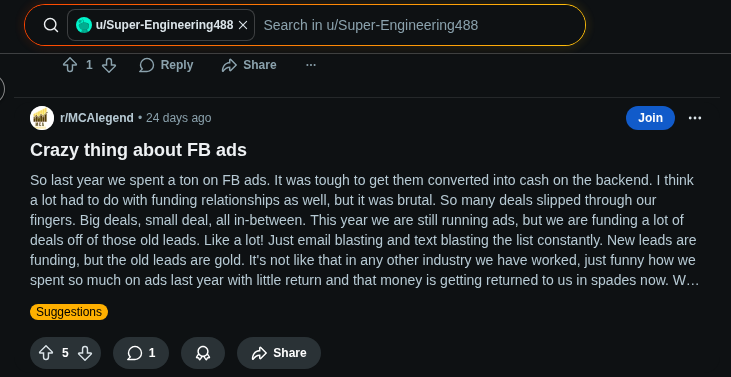
The “crazy thing” about Meta ads is that the money you spend today often returns to you in spades six to twelve months down the line. You have to be “email blasting and text blasting the list constantly.” New leads are great, but the database you build today is the retirement fund for your ISO next year.
Building Your Inbound Engine
You don’t need a $1.3 million budget to compete, but you do need a system that is more efficient than the guys who have one.
If you are tired of the cold calling grind and you want a system that delivers actual files (bank statements included) rather than just “leads,” we should talk. I build the infrastructure that allows you to stop being a “caller” and start being a “closer.”
Here is a value video where I go over what the process looks like for setting up your own in house inbound lead gen system that drives fresh deals into your CRM (avoiding the recycled crap sold by lead vendors industry-wide.
Frequently Asked Questions and Final Notes:
A: In the Merchant Cash Advance industry, a “whale” typically refers to high-revenue merchants seeking fundings between $1M and $6M.
A: To see consistent results and break even early, a starting budget of $500 per day is recommended to provide enough data volume for the algorithm.

1 Response to "If You Want to Fund Whale Merchants ($1M – $6M Deals), You Need To Read This"
I am interested in trying out your service. Can you do this for Mortgage loans as well?